
On the Streamers: Dead Man's Wire
Gus Van Sant returns with a suspenseful true-crime drama.

DEAD MAN’S WIRE
105 minutes; R; directed by Gus Van Sant
Critic’s grade: A
The first frame of “Dead Man’s Wire” is a tight close-up on the moving lips of a radio DJ, cigarette smoke billowing from his mouth as he waxes poetic over the eerie opening strains of Deodato’s funk-fusion take on Strauss’s “Also sprach Zarathustra.”
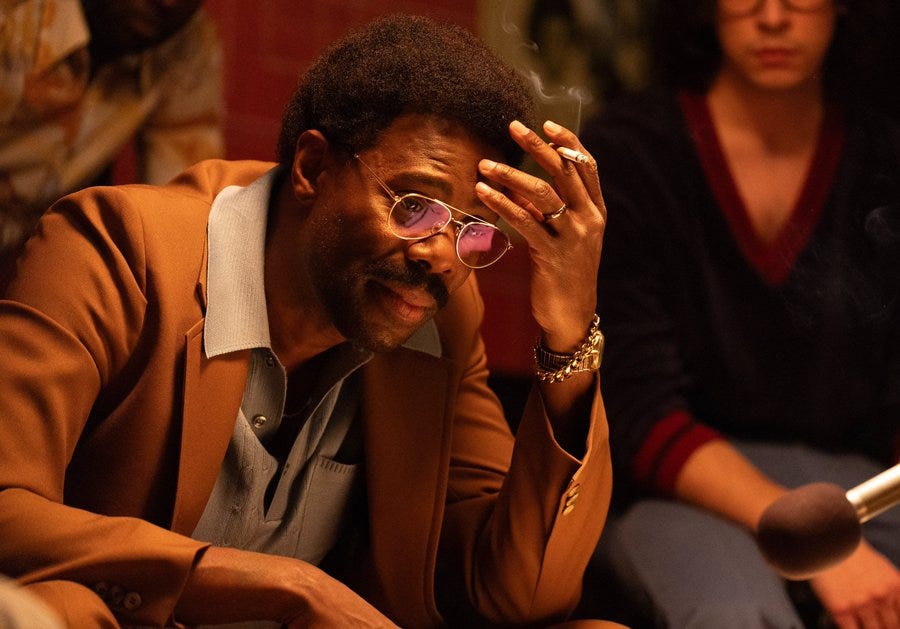
Vinyl rotates on a turntable and a wider shot puts us in the control room of a radio station, where announcer Fred Temple (the reliable Colman Domingo), he of the smoky, deep, resonant pipes, regularly holds forth. He’s an infinitely groovy announcer, a knowledgeable, charismatic man who dispenses nuggets of multiculti wisdom while spinning soul, funk and jazz grooves. Temple calls all men “brother” and likes to sign off with a hearty “peace and love!”
It’s 1977, in Indianapolis, Indiana, and a man consumed by a longstanding beef with a mortgage company is about to walk into a cavernous downtown office building and carry out a potentially fatal plan that will momentarily make news around the country. Coverage of the incident even cuts into John Wayne’s speech at that year’s Oscars. Soon, the local radio celebrity will cross paths with the amateur criminal.
Gus Van Sant’s gritty true-crime film about a man against the system — part police procedural, part social commentary, and laced with dark humor — had me at that opening sequence. The veteran director of such films as “Milk” and “Good Will Hunting” takes us inside an America where a man feels so victimized by a well-funded financial firm that he’s driven to take drastic action. A half-century on, have economic circumstances improved in the United States? Is America’s vaunted “safety net” still intact?
The man who assembled the device of the title, a contraption allowing a loaded shotgun to be placed directly behind a victim’s head, ensuring instant death if/when the wire is tripped, is Tony Kiritsis (Bill Skarsgard). The down-on-his luck fellow’s resume includes stints in trailer-park maintenance and used-car sales and, as a kid, ice cream scooping. “I’m a man of the people,” he declares at one point.
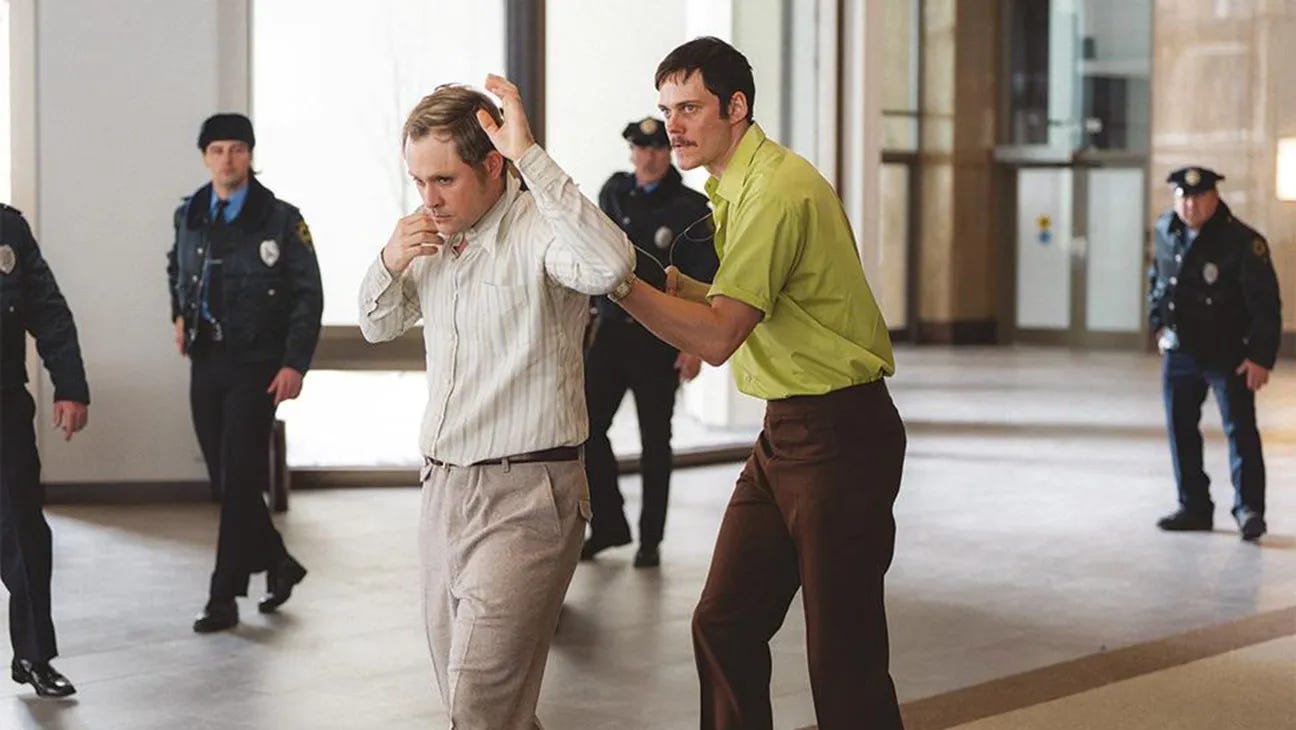
Van Sant, after the opening heist sequence, mostly shuttles among scenes set at Tony’s apartment, a down-market dwelling where his stack of books includes a fictitious one titled “Urban Poor, Rural Forgotten”; the various law enforcement officers strategizing to defuse the situation, including Cary Elwes as the lead detective; and, in a glorified cameo, Al Pacino as the distracted, mostly unconcerned company owner, father of Tony’s hostage, firm president Richard Hall (Dacre Montgomery).
During the 63-hour standoff, Tony makes multiple calls to Fred; Van Sant seems to be taking a sideways swipe at the phenomenon of media outlets that simultaneously cover and participate in stories (inadvertently, in this case).
“You couldn’t let the little guy get a win,” Tony tells the kidnapped man. Van Sant, however, succeeds in creating an often extremely suspenseful, quirky period piece, built on bravado performances, extending empathy to a man on the margins while not excusing the horrific nature of his threat.
Van Sant, too, has a firm handle on the music likely to resonate with those, like me, who tuned in to radio in the ‘70s: In addition to the Deodato track, the soundtrack includes portions of Gil Scott-Heron’s “The Revolution Will Not Be Televised,” Roberta Flack’s “Compared to What,” Yes’s “I’ve Seen All People” and B.J. Thomas hit “Raindrops Keep Falling On My Head.”
The tunes are integral to the pop-cultural fabric against which the events of gritty ‘70s period piece “Dead Man’s Wire” play out, as Van Sant effectively recreates a nearly forgotten crime in the American heartland. Nearly 50 years later, the economic and social forces that drove Kiritsis to commit a desperate, dangerous act — a subtext in such Van Sant films as “Drugstore Cowboy” and “Elephant” — remain alive and well.
Copyright 2026 By Philip Booth. All rights reserved.